Showing posts with label Unit 0. Show all posts

Thursday, September 18, 2014

ZOMG!QUIZ TOMORROW WHAT SHOULD I STUDY I SHOULD PULL AN ALL-NIGHTER!?!?!

No.  It's going to be fine.


If you have been paying attention in class (taking notes, asking questions if you are confused), and reading for understanding (NOT reading for memorization), you will be fine.  You should know and understand everything we talked about in class.  PDFs of the notes are all in the folder.  You should understand the readings- the big ideas of the readings, that is.  I could include a paragraph from the reading on archaea and ask you to explain why it supports classifying these organisms in their own domain.  You can all do that.

If you are still uncertain study with others in the class.  Email me if you must.  If it all truly falls apart we'll talk about a retake.  The point of this quiz (and all future tests and quizzes) is to see what you know and can do.  Just a quiz, people.

Tuesday, September 16, 2014

More Classification

Read and take notes on the following pages regarding the three Domains and four Eukarya Kingdoms.

From Animal Diversity Web on the process of taxonomy

From the Encyclopedia of Life: Archea

Also from EoL: Bacteria, Protists, Fungi, Plants and Animals.  Be aware that there are several characteristics that MOST, but not all animals have.

Reminder- Quiz on Friday covering Characteristics of Life, Classification and Scientific Method


Friday, September 12, 2014

How we classify today

For Homework read the following pages from the Understanding Evolution site by UC Berkeley. You should already know why it is essential for a classification system to take evolutionary history into account.  These pages will teach you more about the methods used to elucidate the evolutionary relationships between various living things.

Begin here, read this page and the next two (to the bottom of the page with the orchids and the cats). You might want to turns these pages into a PDF (using Printfriendly.com) and bring into Notability to mark up your reading and save your notes.

As you read, focus on the ways that phylogenetic trees recount the history of evolution, as well as the reasons that the Linnean system is not as useful now.


Tuesday, September 9, 2014

Characteristics of Life

Two days worth of HW here:

For HW the night after you do the lab, you should write-up a brief summary of the procedure (what did you do and why), the results, and a discussion of your results.  The discussion should include any mentions of errors or issues with the lab/procedures.This does NOT need to be a formal write-up; it's more like notes you would keep in a lab notebook, a narrative (ie, ok to use first person).

For HW the night after the lecture, you should write an introduction of background knowledge about the characteristics of life.

Each person needs to complete this in their own words (not one per group).  Save to your shared folder and turn in using the form.  This doesn't need to be turned in until you've done both days (the lab day and the lecture day), so Squids due Friday, Jellies due Monday.

Monday, September 8, 2014

Let's do some science!!


Time to start putting some skills into practice.  We will be examining the characteristics of life in the lab using yeast.  Everyone knows that yeast is alive, even though it looks completely inert when you take it out of the package.

Your assignment is to come up with an experiment to demonstrate that yeast possesses the characteristics of life.  Choose just one characteristic to focus on.  This experiment needs to be set up, performed and completed (with clean up) in one class period.  Think about:

  • variables and constants
  • control and experimental groups
  • quantitative vs qualitative evidence
  • equipment and materials needed (limited to whatever is available in the lab)
  • what information needs to be recorded for your (brief) write-up

Before leaving class choose 2-3 other people to work with.  For HW, write up a brief procedure addressing the points above (this can be done collaboratively).

Thursday, September 4, 2014

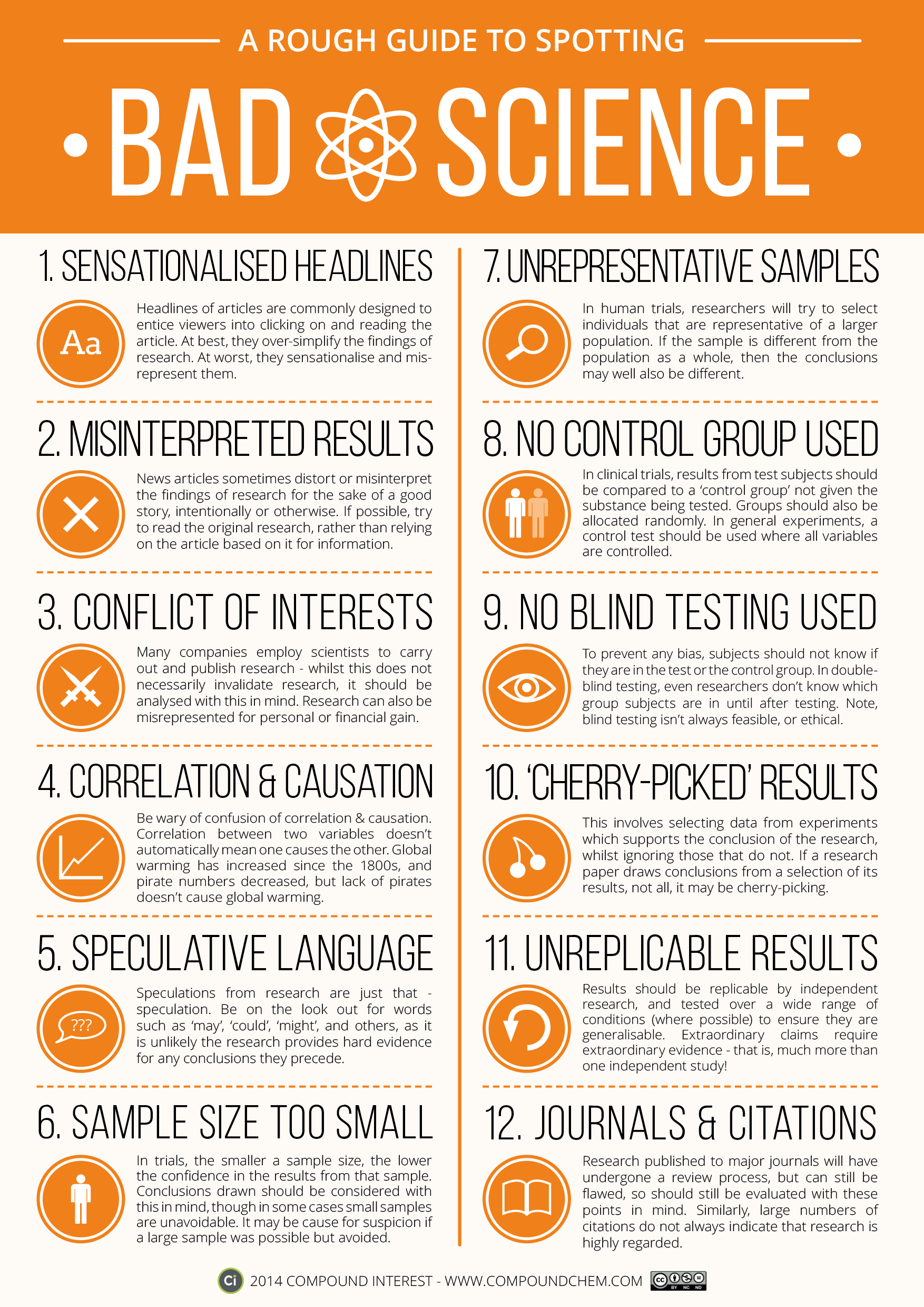
Science Literacy

There are lots of pieces to Literacy in Science.  Some of it is just regular reading and writing (do you understand what the text is about?) but the more sophisticated part is evaluation.  How valid is the claim or results that the author is describing?  What personal or cultural biases might be influencing results or interpretation?  Remember, "science is meant to be objective, but it is practiced by humans, who are not objective."

Choose a recent (within last year) article describing a study within Biology (health and medicine, climate, environment, biodiversity, cells, etc.).  You can choose an article directly from a journal, such as Science or Nature (if you can access the whole thing), or an article from the science section of a popular publication, such as the New York Times.


Your assignment:

1. Read the article.  (Click here for instructions on turning any article into a PDF using Printfriendly.com, in case you want to mark it up in Notability).  Read it for comprehension and to evaluate the validity of the results.

2.  Write a 2-3 paragraph summary of the article.  Briefly describe the methodology and results.  Discuss any factors that might affect the validity of the results.

3.  Drag your document into the Drive folder you shared with me (a few of you haven't made your folder yet!).  Then, copy the link and go here to turn it in.  Save this link for future use.

**Almost forgot- please return your signed safety contract as well**

Due by the start of the next class meeting (Monday the 8th for both sections).

Here, this should help you get started (from compoundchem.com)